
Origins, Rabbi Abraham Y. Rice & Battles with Reform:
Shearith Israel Congregation has played an outsized role in the foundation of Orthodox Judaism in Baltimore. Its continued success as a congregation nearing a century and a half of age (at least) while maintaining its current location for 100 years is quite rare in America. Shearith Israel is the oldest continually Orthodox synagogue in Baltimore.

Founding:
There is controversy regarding the official founding date of Shearith Israel Congregation.
Some mark 1851 as the founding date, founded on Howard Street by Rabbi Abraham Joseph Rice (also spelled as Reiss), the first ordained rabbi in the United States. Rabbi Rice was brought to Nidche Israel (Baltimore Hebrew Congregation, incorporated 1830) in 1840, asked by a fellow landsman of Wurzberg, Bavaria, Mr. Aaron Weglein, to come from New York to visit the synagogue on Harrison Ave. and Aetna Lane in Baltimore, after a failed attempt to resuscitate a shul in Rhode Island. At the time, “the whole [Baltimore]Jewish population … aggregated less than 200 families.” Most of these families were German immigrants, but about 12 families were native to Baltimore of several generations, and while of German ancestry, they would worship in the Portuguese minhag.
Below you will find the memories of William Rayner upon the 50th anniversary of Har Sinai Verein in 1892. Rayner was a well-known successful Baltimore merchant who arrived in New York on the very same ship as Rabbi Rice on July 25, 1840,

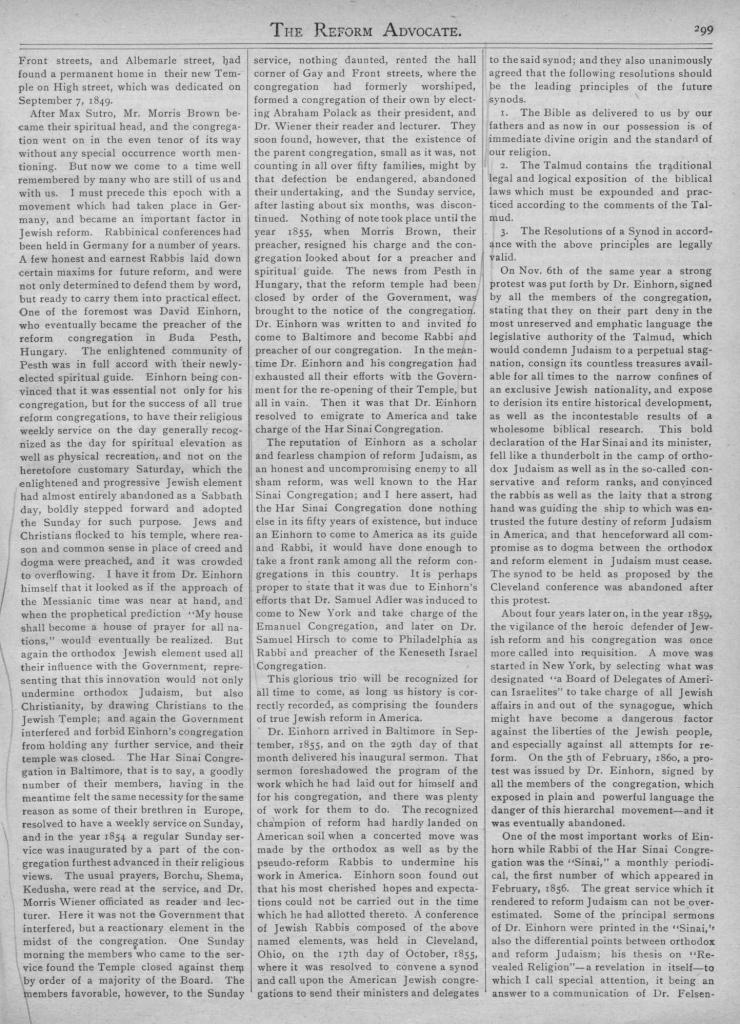

Rayner would become president of Har Sinai Verein and would build the Hebrew Orphan Asylum and found the Hebrew Benevolent Asylum.
In all writings of Rabbi Rice, he was considered “sincere, upright, and honest, true to his religious convictions,” as Rayner states, even to his greatest foes in the Reform world.
Rabbi Rice presided over the dedication of the congregation’s new edifice at Lloyd Street in 1845 (still called the Lloyd St. Shul to this day).
Rabbi Rice became the preeminent posek of his time, fielding letters from all over the country. He also spent a tremendous amount of time battling German reformers not only in his synagogue, and not only in Baltimore, but nationally, famously fighting with Isaac Mayer Wise, the leading reformer of his time in such publications as Isaac Leeser’s “The Occident and American Jewish Advocate.”

But the great wave of German reform swept up Baltimore Hebrew, as much of American Jewish life at the time, fueled by German reformers. Har Sinai Verein, now known as Har Sinai-Oheb Shalom, was founded in 1842 following Rabbi Rice’s vocal protestations of Masonic rites used at Jewish funerals of his congregants, notably at the funeral of a Mr. Jacob Ahrens.
Har Sinai Verein was the first organized Reform congregation in America, with its first services on Rosh Hashana 1942 at the corner of Baltimore St. and Post Office Ave.
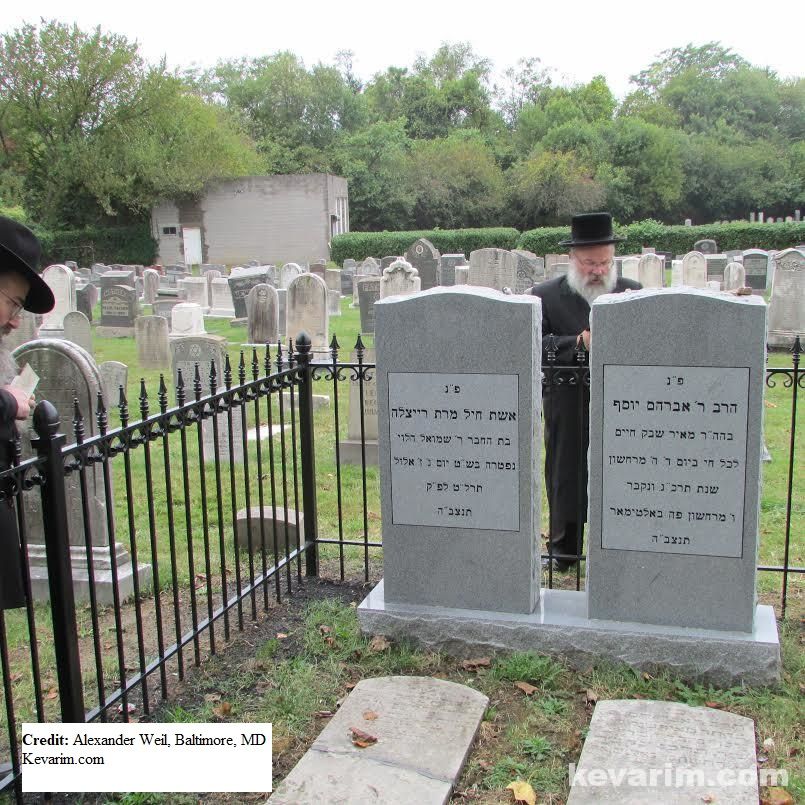
Bear in mind the vast majority of American Jewry in the middle 19th century was German, as Bavarian Jews were fleeing pogroms at that time. Rabbi Rice would leave Nidche Israel in 1849 to begin his own shul with his small group of ardently Orthodox adherents. This is a story that is best told in “The First Rabbi,” a book I highly recommend. Rabbi Rice would pass away on October 29, 1862, shortly after being cajoled into returning to Nidche Israel (Baltimore Hebrew).
At this time, many officers in the Orthodox Nidche Israel were also officers in Har Sinai Verein, a truly unique situation.
Rabbi Rice died on Rosh Chodesh Cheshvan, 1862, and is buried in the old BHC cemetery on Belair Road.
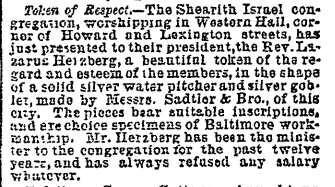
Shearith Israel seceded from the Howard Street Shul (which was Rabbi Rice’s residence), and was known as the Gay Street Shul.
This secession was based on minhag/nusach, which Isaac Meyer Wise used to deride Orthodoxy and promote his Minhag Israel reform prayer book.

In any case, on April 1, 1879, another small congregation, Shevet Achim of 21 Eutaw Street, which was formed in 1862, merged with Shearith Israel to create a larger synagogue. 1879 is the date commonly used by Shearith Israel as the date of founding.

Shevet Achim Congregation was located on the second floor of 21 North Eutaw Street in the former Eutaw Savings Bank, which would move just across street into a larger building. This building is on the National Register of Historic Places. It is just across street from the Hippodrome Theatre and backs into the Everyman Theatre.
In 1879, Shevet Achim would merge with Shearith Israel Congregation, which was begun by the famed “First Rabbi,” Rabbi Abraham Joseph Rice, who had come to America to become rabbi of Congregation Nidche Israel. Rabbi Rice would leave in 1849, tired of fighting his congregation’s push toward reform. He returned very briefly in 1862 after the congregation pledged to remain Orthodox. He would die shortly after. In the years between 1851 and 1862, Rabbi Rice would maintain a congregation of his stalwart Orthodox congregants, which he named Shearith Israel Congregation, which was at the southwest corner of Howard and Lexington Streets. This was also referred to as “The Fifth Synagogue,” owing to its chronological establishment in Baltimore.


Historical importance:
Shearith Israel is the oldest continually-Orthodox synagogue in Baltimore. Other synagogues founded as Orthodox came before it but changed denominations, with the two examples of Baltimore Hebrew Congregation (1830) and Chizuk Amuno Congregation (1870, itself an Orthodox breakoff of Baltimore Hebrew when it turned Reform – Chizuk Amuno would become Conservative in 1940).
Like much of Jewish Baltimore, the congregation has followed the northwest trajectory of the population. The congregation has occupied buildings at:
- Greene Street at German (renamed Redwood after WWI) Street, 1879-1903
- 2105-2107 McCulloh Street, 1903-1958.
- 5813 Park Heights Avenue at Glen Ave., 1925-current.
- A small branch for those still downtown would exist from 1958 to until approximately 1967 at 2107 Brookfield Avenue
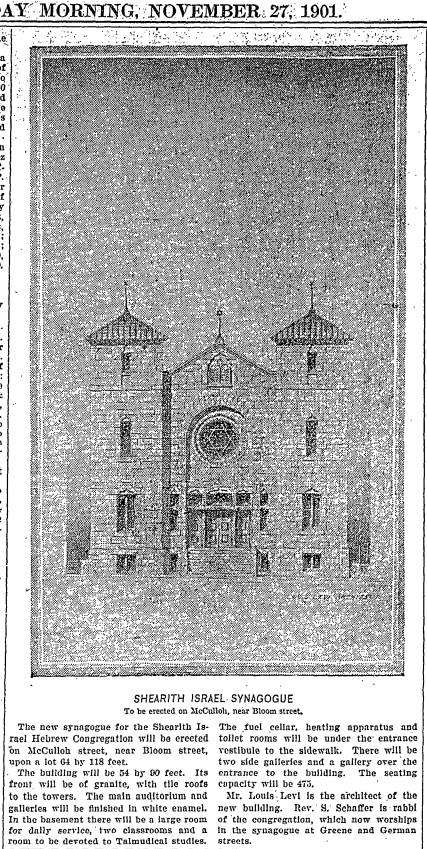
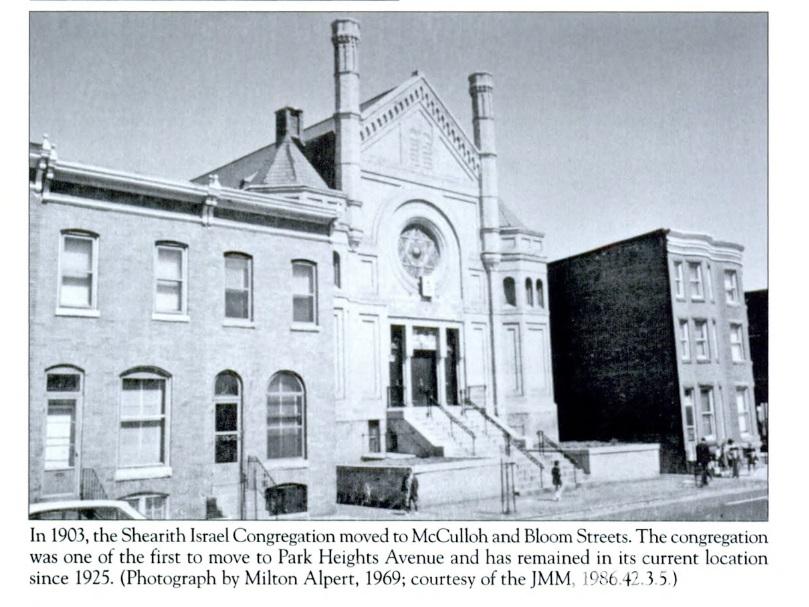
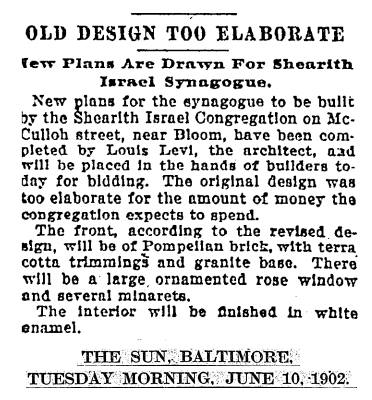
Courtesy of Fred Shoken, local historian: “The original design [of Shearith Israel] was a bit more elaborate. The Baltimore Sun printed an elevation of the proposed design on November 27, 1901 and stated it was to be built of granite with two towers and tile roofs. This would have been reminiscent to some degree of nearby reform temples of Oheb Shalom on Eutaw Place and Baltimore Hebrew on Madison Avenue. But the plan proved to be too expensive to build. A little over six months later, the Sun printed a brief article that the revised design was of Pompeiian brick. When comparing what was built to the original design, in addition to less expensive materials, the towers were also reduced in size leaving two minarets to flank the central bay. Also it should be noted that a Jewish architect, Louis Levi, was responsible for the design. Most of the other German congregations had designs prepared by Joseph Evans Sperry.
The 1920s saw a change in the neighborhood of the McCulloh Street shul, and the move northward and “uptown” of the more affluential members of Shearith Israel. A “suburban” branch of Shearith Israel would be constructed on the corner of Glen and Park Heights Aves. and dedicated on August 30, 1925. In the interim, Sabbath services were held at the home of Samuel Rauneker on Homeland Avenue, then 3608 Menlo Drive, followed by a cottage at (what was then) 16 Glen Avenue, between Park Heights Avenue and Reisterstown Road.

The 1930s would bring a major membership controversy after the hiring of Rabbi Schwab. A majority of congregants (some 90%) were not officially considered voting members as they were not Sabbath observant.
This was a very representative story of Baltimore of this era, with the “Orthodox synagogues trying to hold the fort,” in the phrasing of Rabbi Dr. Dovid Katz in his podcast “Nathan Adler Sr. and Rabi Shimon Schwab: A Baltimore Story.” Reform was quite strong heading into the 1920s in Baltimore and the leading reform congregations of Baltimore were Har Sinai, Oheb Shalom, and Baltimore Hebrew Congregation. The Conservative branch was on the rise, to reach its peak in the 1940s and 1950s. Chizuk Amuno, one of the founding synagogues of the OU, and an Orthodox secession from Baltimore Hebrew’s Reform swap, would also become one of the founding synagogues of the Jewith Theological Seminary. So “Orthodoxy was quite anemic” at this time, according to Rabbi Katz, “and even the people in [Shearith Israel] were on the “shvach side,” with notable familial exceptions such as Nathan Adler.
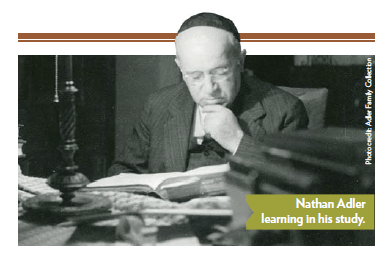
So Rabbi Schwab’s election would be pivotal in keeping the congregation strictly Orthodox.
These congregants, non-voting but carrying much of the financial strength of the congregation, pushed strongly for change with threats of secession, but Rabbi Schwab would rule in 1938 that Sabbath observance would remain a regulation for membership.
Following this ruling, Beth Jacob Congregation would be founded immediately, just a block from Shearith Israel, at the corner of Park Heights Avenue and Northern Parkway to 5713 Park Heights Ave.

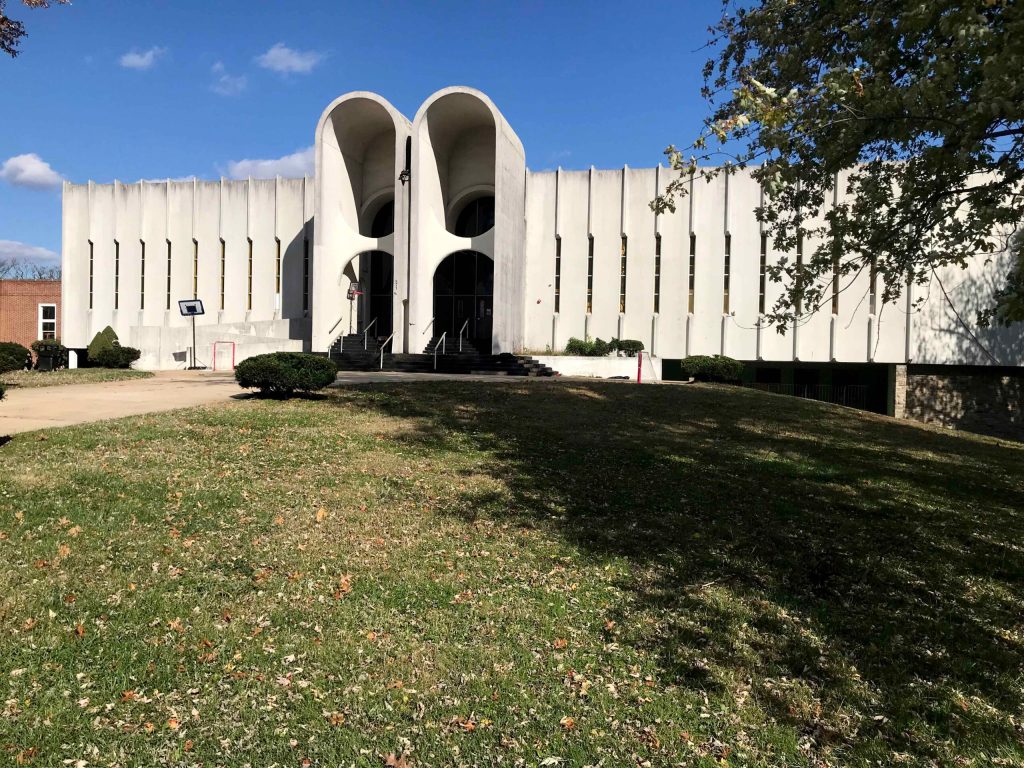
Rabbi Dr. Bernard Lander would serve as the first rabbi before heading back to N.Y. to continue advanced studies. He would ultimately found Touro College. When Lander came to Baltimore as a newly minted and newly hired rabbi, he was not them married, and would eat often at the home of Rabbi Schwab, and consult Rabbi Schwab on his sermons. Rare mentschlichkeit.

By the 1950s, Beth Jacob would become the largest shul in Baltimore with about 800 families. Still, within just a couple generations, by the 1980s many of its members had passed away or moved on, and the shul merged into Beth Tfiloh (3300 Old Court Road) on March 8, 2007. The Beth Jacob building is now a yeshiva, Cheder Chabad of Baltimore.
Of course, because of the impending doom of the Nazi Holocaust in Germany, refugee families who were able to flee would help populate Shearith Israel. Some of these families include the Bambergers, Flamms, Steinharters, Hesses, Gutmans, and Schlossbergs, and many other names well-known to Baltimoreans today.
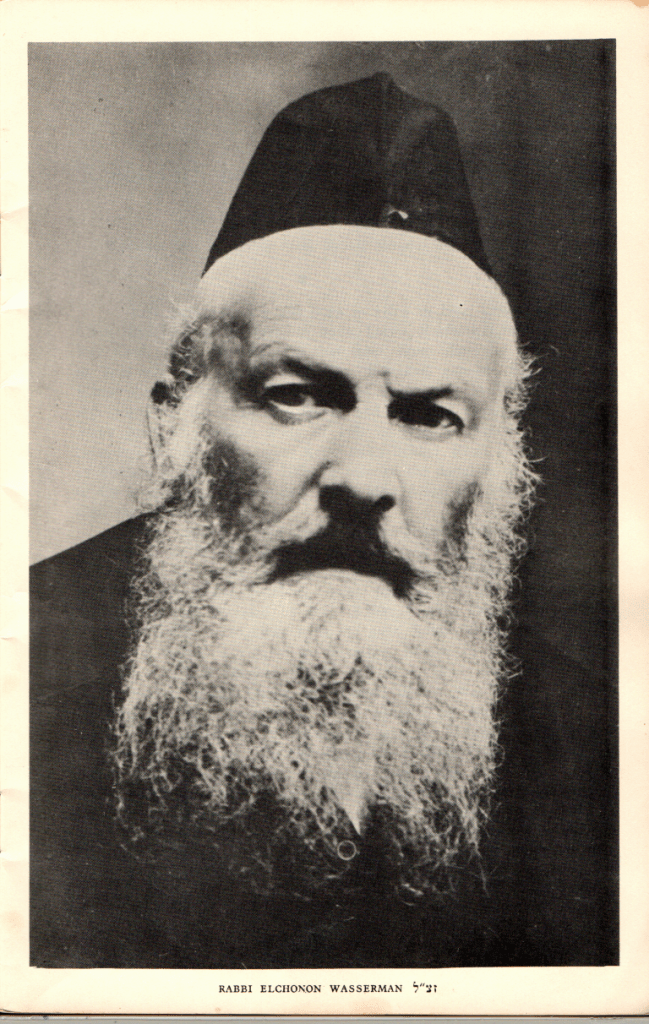
A famous 1930s visit by Rabbi Elchonon Wasserman, who stayed at the home of Rabbi Schwab, would effectively bring the end of mixed shul dances. As quoted in Earl Pruce’s book, “The second annual dance and entertainment of the congregation at Park Heights and Glen Avenues took place at the Southern Hotel on March 22, 1936.” R’ Wasserman would publish a kol koreh forbidding mixed dances, which would ease Rabbi Schwab’s burden into effecting this rule. The majority of Baltimore’s Orthodox rabbinate would sign on.
The late 1970s saw a decline of the shul as the community was moving northwest and new German members were not replacing the older ones. The traditional German service was out of sync with the younger community. By 1986, the shul would consult with Rabbi Shlomo Zalman Auerbach about switching the service to Nusach Ashkenaz, to which Rabbi Auerbach agreed, asking that the shul maintain some of the minhagim or traditions of the Ashkenazic service.

With the founding of the organization, CHAI (Comprehensive Housing Assistance, Inc.), in 1983, the Upper Park Heights neighborhood of which Shearith Israel and the Jewish Community Center were long time anchors would get a major boost of stabilization, making home ownership in the neighborhood affordable to couples who might not otherwise have been able.
To this day, Shearith Israel maintains a position of great importance in the Baltimore community, serving as a landmark institution of the Park Heights community. Its rabbi, Rabbi Yaakov Hopfer, is President of the Vaad HaRabbonim of Baltimore, and many prominent members of the community are members of the synagogue.
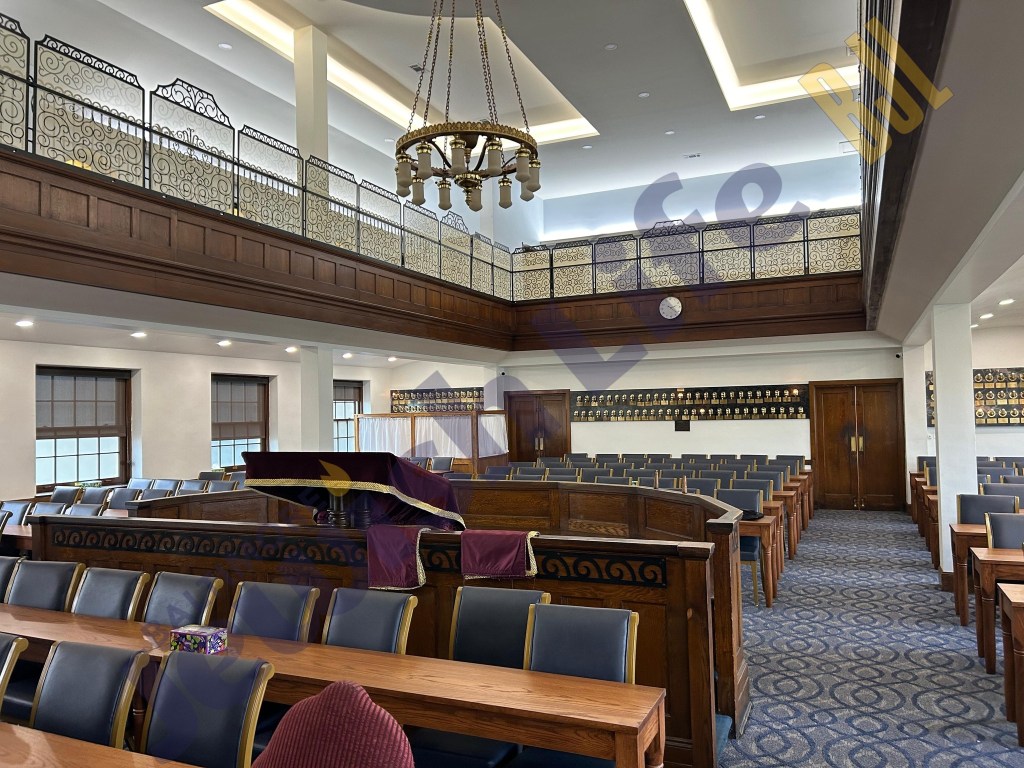
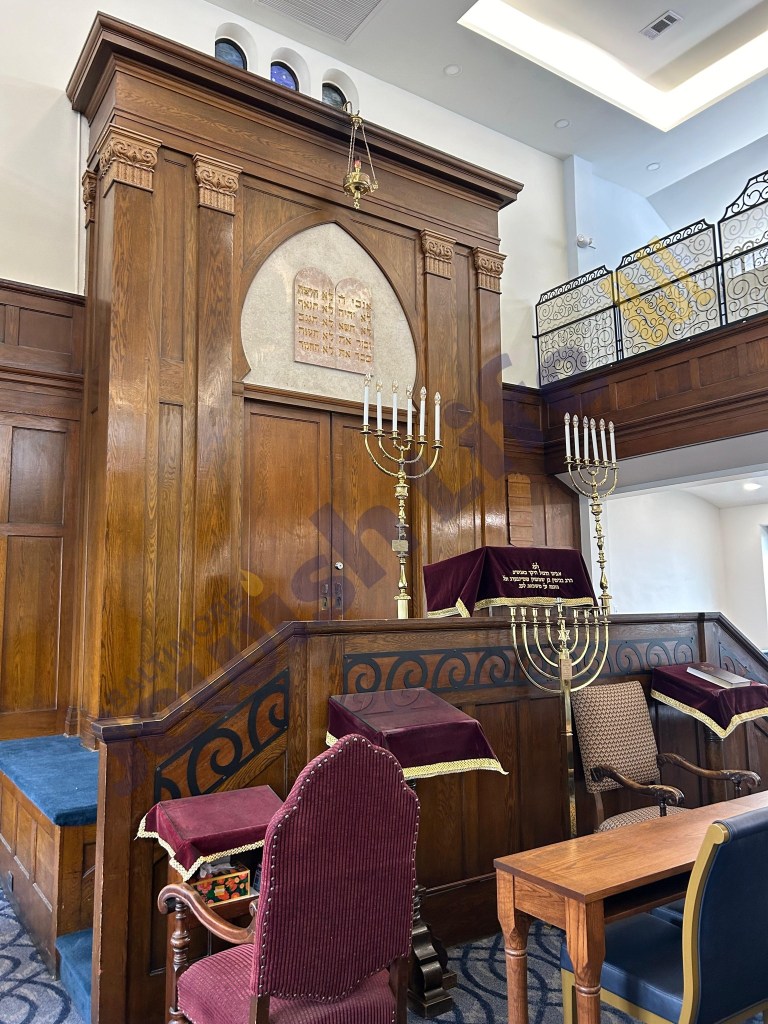
Recent renovations, including removing the original pews and placing tables and chairs in the main sanctuary and improving the social hall, have renewed Shearith Israel to continue its central role for years to come.
Rabbis:
Shearith Israel is also famous for having had only four rabbis (five, if you include Rabbi Rice and bring back the date of founding to 1851) in its history.
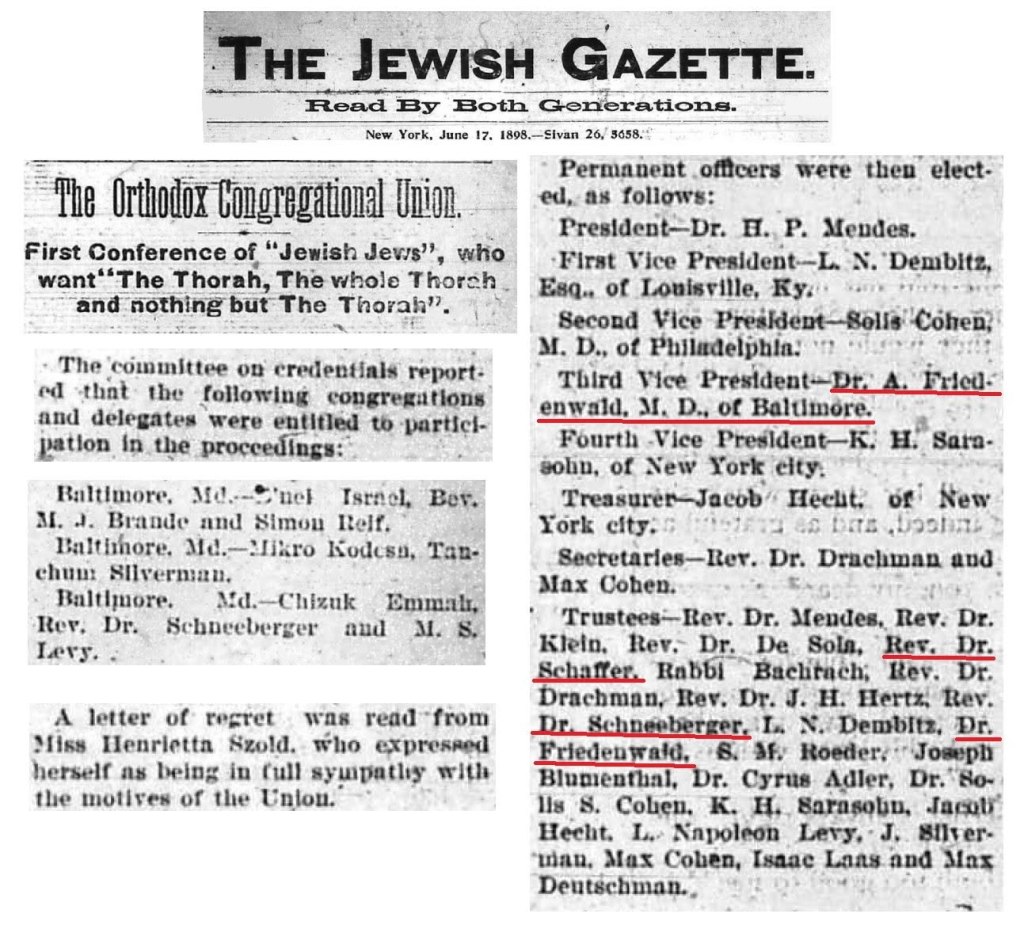
Rabbi Schepschel Schaffer, 1893-1928

Rabbi Schaffer was born not in Germany, but in Bausk, Russia on the 1st day of Shavuos, 5622 (May 4, 1862), the son of a melamed, and grandson of the sage, R’ Jacob Schaffer, and maternal grandson of R’ Yedidiyah Jaffe (Bausker). Rabbi Dr. Schaffer would receive his semicha at the rabbinical seminary of Dr. Azriel Hildesheimer, arriving in Berlin, German in April 1883. By 1885 he would enter the University of Berlin, but would receive his PhD from Leipzig in 1889. In 1890, he would receive semicha from the Rabbiner-Seminar. He would return to Russia, as the chance to get a pulpit in Germany was slim considering he was not a native. He would then receive semicha from Rabbi Alexander Moses Lapidoth in Rossieny (whose youngest daughter, Anna Lapidoth, also of illustrious heritage, would marry Rabbi Schaffer in 1893), as well as Rabbi Abraham Diamant of Yurburg (in Lithuania) and Rabbi Ze’ev Lehrman of Erzviloh, then receiving ordination from Rabbi Isaac Elchanan Spector in Kovno.
Around this time, Congregation Shearith Israel had decided it was time to search for a rabbi. Rabbi Schaffer would set out for America with no job in his sights. While at sea, the trustees of Shearith Israel, including the famed Strauss brothers, wrote to Dr. Hildesheimer for a recommendation for a rabbi, and Dr. Hildesheimer replied that one of his best students was on a boat to America.
Rabbi Schaffer would be invited for a trial on December 3, 1892, Parashas Vayishlach. By this time, most of his family was living in New York, including his aged mother. He would head there only to return to Baltimore in January, 1893, when he would begin his job as the first rabbi of Shearith Israel. Anna and her sister would arrive in March, when Anna would marry Rabbi Schaffer in the synagogue.
“In 1893 the Baltimore Jewish community consisted of between twelve to fifteen thousand Jews of German origin.” (Levine, https://personal.stevens.edu/~llevine/forty_years_schaffer_34.pdf)
German immigration, both Jewish and non, were at a peak in the mid-19th century. “The year 1854 was a peak year of German immigration. Of a total of 427,833 newcomers who arrived in the United States, 215,009 came from the German Confederation (including then Austria and Luxembourg), i.e. about as many people in a single year as the total number of German immigrants of the entire 18th century. The captains’ lists as published in the Correspondent account for 8665 passengers from German ports alone.” (Pritchett, Wust https://loyolanotredamelib.org/php/report05/articles/pdfs/Report38Pritchettp52-109.pdf)
Baltimore, on a whole, was a very German city, reflected still today in the city’s culture.
At the time, only six larger congregations existed in Baltimore, of which only Shearith Israel and Chizuk Amuno were Orthodox. Shearith Israel of 1893 had about 50 “members” and far more “seat holders.”
Rabbi Schaffer was, interestingly, an ardent Zionist, and was elected president of the first American branch of the Chovevei Zion. He represented the Zionists of America at the International Jewish Congress in Basel in 1897, and was one of the 15 American delegates to the 5th Zionist Congress in 1901.
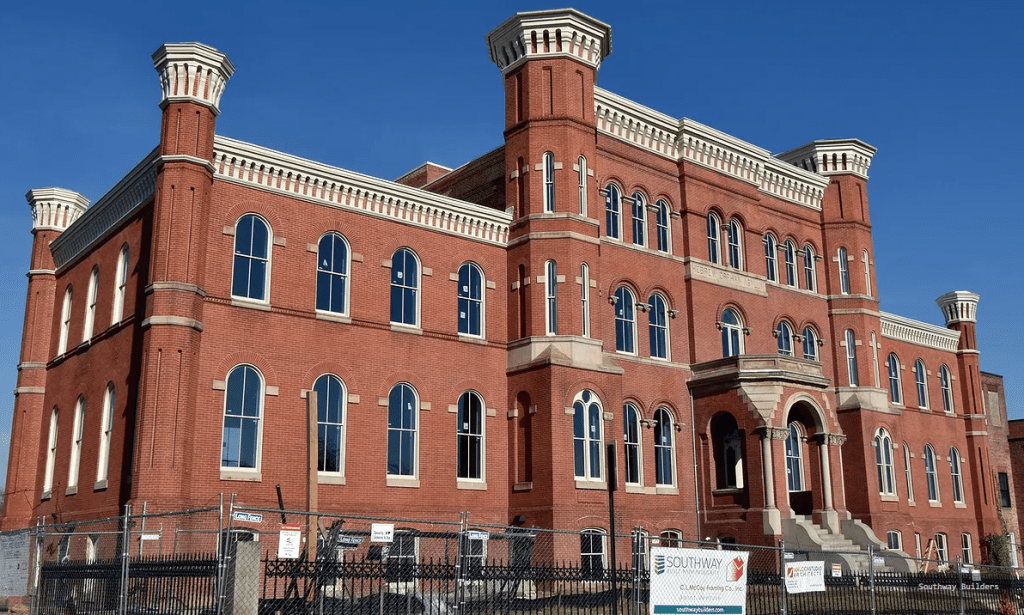
By 1903, many congregants were moving from the southwestern to the northwestern part of the city, so Moses Strauss deemed it necessary for the shul to follow. The shul would move in 1903 from its original 1879 location at Greene Street at German (renamed Redwood after WWI) Street to 2105-2107 McCulloh Street, where it would reside until 1958. The building was designed by Louis Levi and dedicated on September 11, 1903.
The uptown branch at Glen Avenue would begin being built on July 14, 1924, and would begin being used on May 11, 1925. A small branch for those still downtown would exist until approximately 1967 at 2107 Brookfield Avenue.
(Source: Reverend Doctor Schepschel Schaffer: Twenty Five Years of Activity in the Cause of Orthodox Judaism)
Upon his arrival, Rabbi Schaffer immediately began giving “biweekly sermons,” and instituted the custom of giving a shiur before mincha on Shabbos. [Rabbi Schaffer] “also began giving a Gemara Shiur four times a week. By 1918 those who attended regularly had completed Shas!” (Levine, https://personal.stevens.edu/~llevine/forty_years_schaffer_34.pdf)
It was not uncommon for German Orthodox families to marry into Reform families, as the pool of eligible Jewish singles was not large. One of Rabbi Schaffer’s sons, Dr. Alexander Schaffer, was married to Ruth Hutzler, daughter of Louis S. Hutzler, of department store fame. Louis was the grandson of Moses Hutzler, an original founder of the reform Har Sinai Congregation.
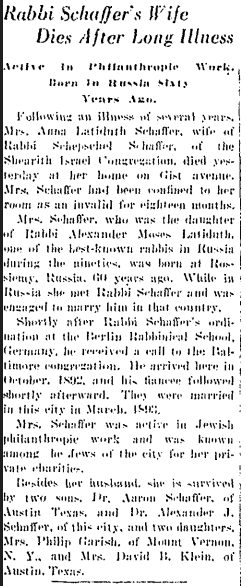
Anna Schaffer would pass away on February 19, 1927.
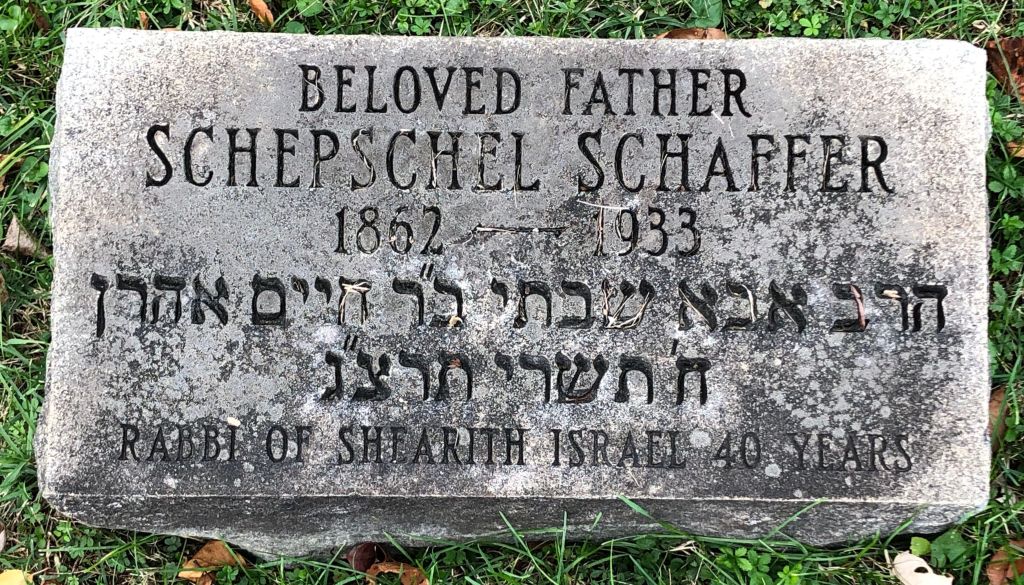
Rabbi Schaffer would serve as rabbi until his death on September 28, 1933. He is buried at the Baltimore Hebrew Cemetery on Belair Road.
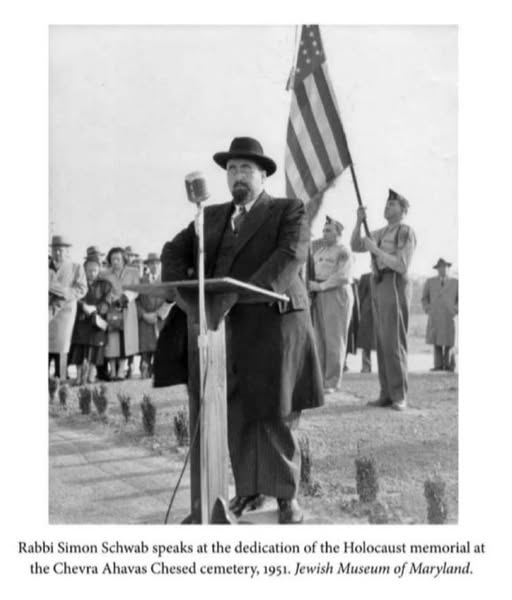
Rabbi Shimon Schwab, 1937-1958
Following the passing of Rabbi Shaffer in 1933, the shul would elect Rabbi Shimon Schwab,
Rabbi Schwab would meet with the influential New York rabbi, Rabbi Leo Jung in the summer of 1936 in Zurich, seeking advice on finding a rabbinical position in America. Rabbi Schwab had written a book, “Heimkehr ins Judentum,” or “Coming Home to Judaism,” and based on this philosophy, there was only “one suitable position” in America, that of Shearith Israel, and that Rabbi Schwab should contact his friend, Nathan Adler, upon his recommendation.
Rabbi Schwab’s book was a criticism of the Hirschian philosophy of Torah im derech eretz in the lens of Germany following World War I. Rabbi Schwab’s training in the great yeshivas of Poland and Lithuania was a testament to these ideas.
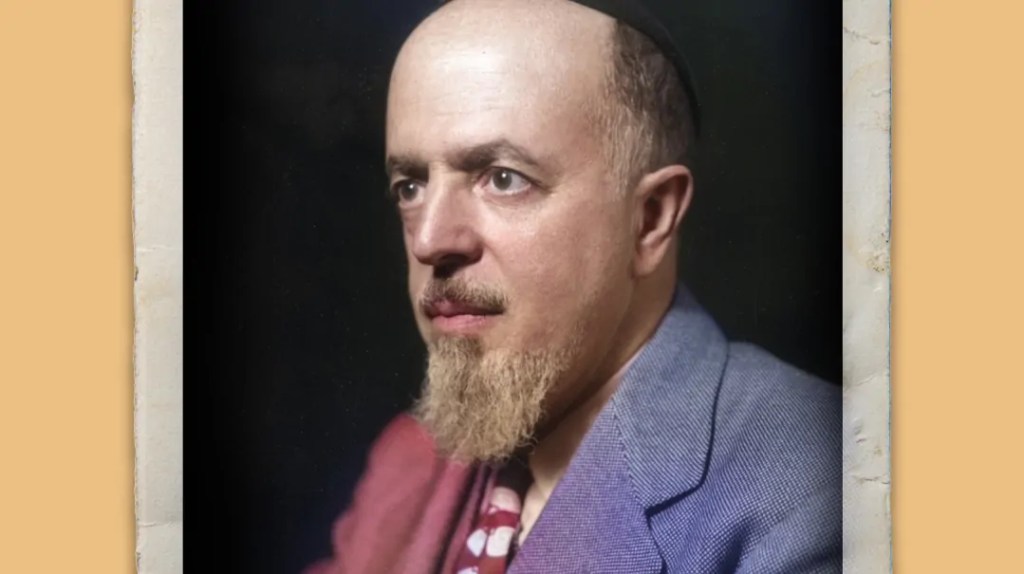
A humorous story told over by Rabbi Schwab’s son sits within the miracle of his hiring by Shearith Israel of Baltimore. This job at Shearith Israel would likely save Rabbi Schwab’s life.
“Arrangements were made for my father to come to Baltimore as a candidate for the rabbinical position on Shabbos Parshas Ki Tzeitzei, August 29, 1936. Rabbi Schwab spoke in Shul, in a labored English, on Shabbos morning, and in the afternoon he gave shiurim in Yiddish for the Balei Battim. Then, on the following Sunday evening, he again addressed the congregation in English. Afterwards, Rabbi Schwab was told that the congregation would have a meeting to decide on his candidacy between Rosh Hashanah and Yom Kippur, and my father returned to Ichenhausen to await the outcome. On the 4th of Tishrei, September 24, 1936, my father received a telegram, with the words, “Unanimously elected” … My father’s English was so rudimentary that, while he knew what “elected” meant, he did not understand the meaning of “unanimously,” thinking it had a negative connotation as in “un,” meaning “not.” It was only after he consulted his well-thumbed English-German dictionary that he made the brocho, “Baruch hatov v’hametiv.”


July 1, 1936 letter from Rabbi Shimon Schwab, who was then the “Betzirksrabbiner,” or District Rabbi, of Ichenhausen, Bavaria, to Mr. Nathan Adler of Baltimore, regarding a position at Shearith Israel Congregation. Rabbi Schwab would serve as rabbi of Shearith Israel from 1937-1958 before leaving for Washington Heights’ Khal Adath Jeshurun from 1958 until his death in 1995. Thank you to my friend, and local historian, Eli W Schlossberg, for this document.
In 1937, at the time of R’ Schwab’s hiring, Shearith Israel maintained two shul locations:
- (The still-standing building at) 2107 McCulloh Street, at Bloom Street.
- The suburban branch, 5813 Park Heights Ave., which was erected in 1925.
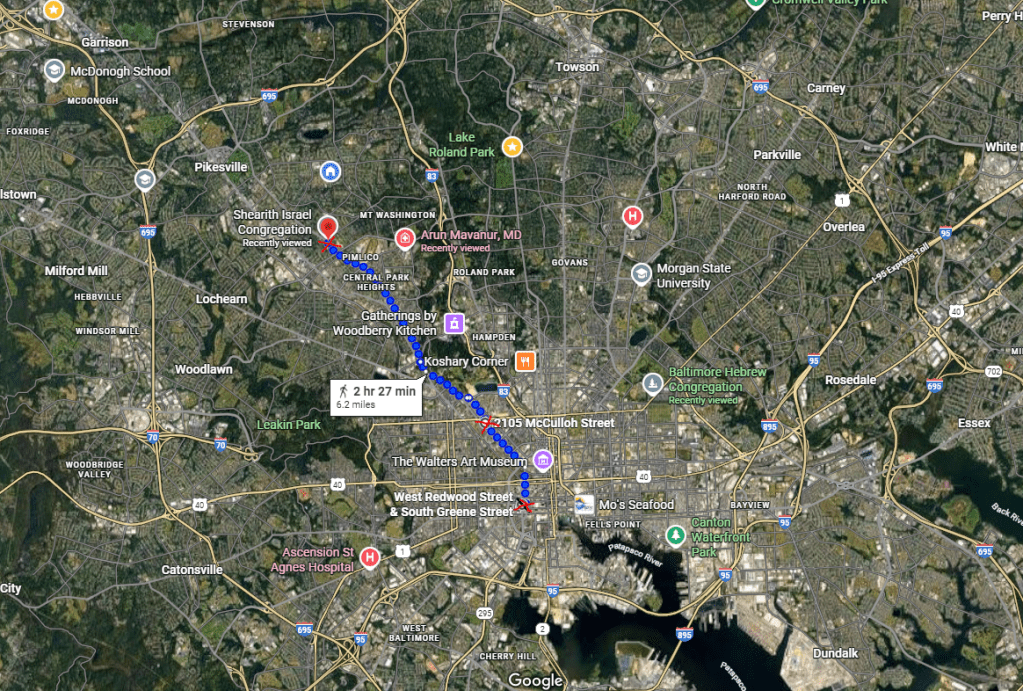
Both buildings operated between 1925-1958, when the McCulloh Street synagogue closed. By contractual agreement, in his early years, Rabbi Schwab would walk to the downtown shul from his home on Narcissus Ave. southward down Park Heights Avenue once a month, a distance over 4 miles. This was “discontinued when most of the old-time members who were left moved closer to Glen Avenue,” (Moses Schwab, “Memories of Shearith Israel) though Rabbi Schwab would remain rabbi of both congregations until leaving for N.Y. in 1958.

Mike Tress, Agudath Israel, third from left.
R’ Moshe Sherer, Chairman of Agudath Israel, 2nd from left.
Nathan Hausman, Vaad Hatzalah, seated next to R’ Schwab.
Agudah Dinner, 1943.
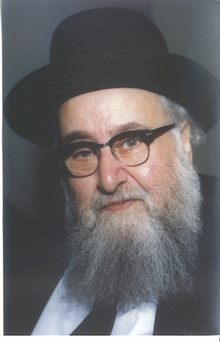
Rabbi Mendel Feldman, 1958-1986
Rabbi Menachem Mendel Feldman (haKohen) was born Jan. 9, 1920 in Brooklyn, New York and studied at Yeshivas Tomchei Temimim and was a “Ben Bayis” of the previous Lubavitcher Rebbe, Rav Yosef Yitzchak, then went to Yeshivas Torah Vodaas. He assumed his first pulpit in Jacksonville, Florida. In 1958, he succeeded Rabbi Shimon Schwab as rabbi at Shearith Israel Congregation (1851/1879) when R’ Schwab moved to Washington Heights, N.Y. to assume the pulpit of Khal Adath Yeshurun.
Henry P. Cohn, president of Shearith Israel in 1958 appointed a search committee headed by H. Milton Lasson then Dr. Eugene Kaufmann (head of HIAS), which would recommend Rabbi Feldman. Rabbi Schwab consulted on the committee. It was an interesting choice, as Rabbi Feldman was not only not of German heritage, and born in America, but was a Lubavitcher chasid. Rabbi Feldman accepted the position on July 29, 1958.
Rabbi Feldman also taught and was a rosh yeshivah of Talmudical Academy of Baltimore. He was a chavrusa of Rabbi Moshe Heinemann of Agudath Israel of Baltimore (1981).
Rabbi Mendel Feldman was rabbi of Shearith Israel from 1958-1986 followed by founding and assuming the pulpit in 1987 at Khal Ahavas Yisrael Tzemach Tzedek, 6811 Park Heights Avenue. Rabbi Feldman would become rabbi emeritus upon his retirement, and after his wife passed away, he would move to Australia in 2004 to join his son, Rabbi Pinchas Feldman, of New South Wales, an emissary of the Rebbe, R’ Menachem Mendel Schneerson. Rabbi Feldman passed away at the age of 88, 16 Kislev, 5769, December 13, 2008. He was buried in Rookwood Cemetery in Australia.

Here is video of Rabbi Feldman speaking about the special relationship between the Rebbe and the previous rebbe, the Friederker Rebbe.
Here are memories of Rabbi Feldman from Rabbi Elli Fischer.

Chazan David Baum was well-known as the cantor of Shearith Israel during Rabbi Schwab and Rabbi Feldman’s time.

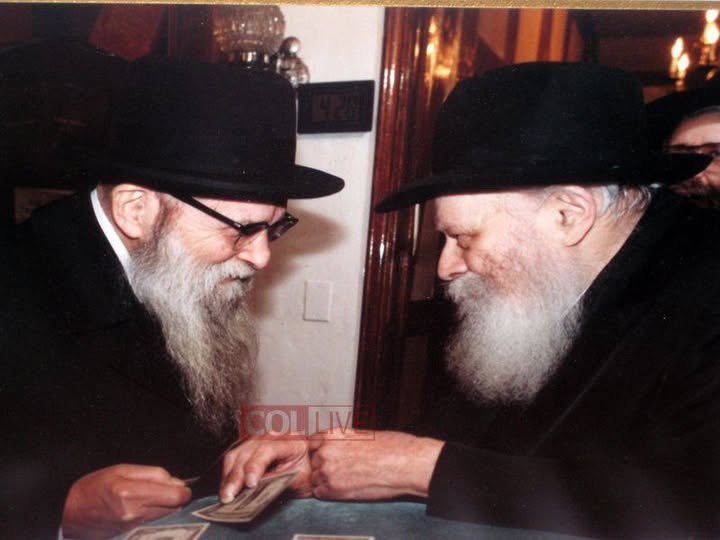
Rabbi Menachem Mendel Feldman (haKohen) was born Jan. 9, 1920 in Brooklyn, New York and studied at Yeshivas Tomchei Temimim and was a “Ben Bayis” of the previous Lubavitcher Rebbe, Rav Yosef Yitzchak, then went to Yeshivas Torah Vodaas. He assumed his first pulpit in Jacksonville, Florida. In 1958 he succeeded Rabbi Shimon Schwab as rabbi at Shearith Israel Congregation (1851/1879) when R’ Schwab moved to Washington Heights, NY. Rabbi Feldman also taught and was a rosh yeshivah of Talmudical Academy of Baltimore. Rabbi Feldman led Khal Ahavas Yisrael Tzemach Tzedek for 20+ years before emigrating to Australia in 2004. He was a chavrusa of Rabbi Moshe Heinemann of Agudath Israel of Baltimore (1981).
Rabbi Yaakov Hopfer, May 12, 1987-current
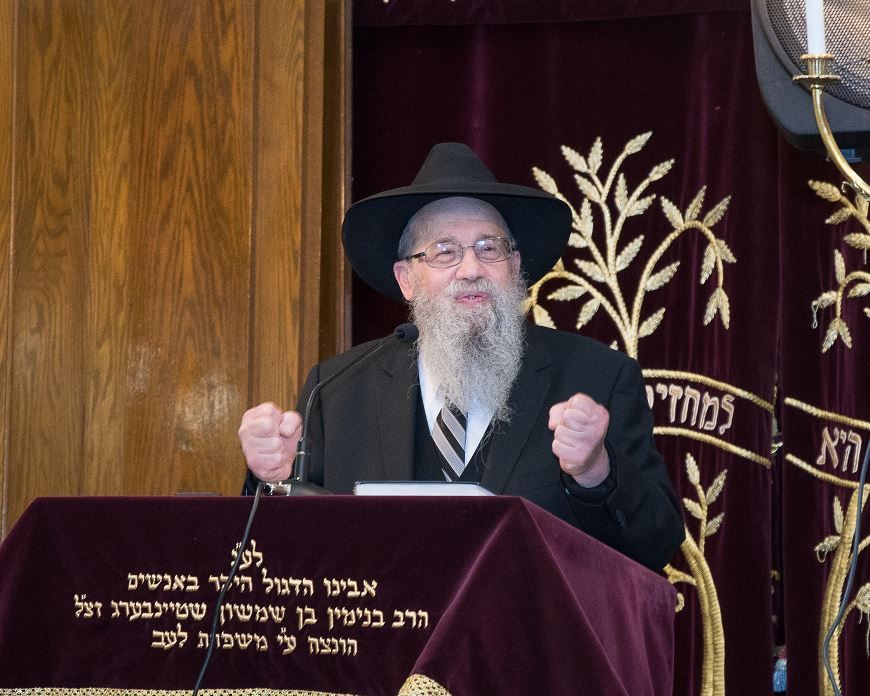
Rabbi Yaakov Hopfer was elected by the congregation on May 12, 1987. He was formerly the rabbi of Congregation Zera Avraham of Denver, Colorado, between 1980-1987.
Rabbi Hopfer is the president of the Vaad HaRabbonim of Baltimore. Rabbi Hopfer has overseen a rebirth of the historic Baltimore shul, which is still thriving today.
Shearith Israel Locations:
- From 1879-1903, Shearith Israel was located on Greene Street, at German (now Redwood – also an interesting story) Street, in the old building of the Calvary Methodist Episcopal Church South.
- From 1903-1958, Shearith Israel occupied a newly-erected, and still-standing building, at 2107 McCulloh Street, at Bloom Street. Dedication occurred on September 11, 1903.
- In 1925, another synagogue was erected at the corner of Glen Avenue and Park Heights avenue, at 5813 Park Heights Avenue, to serve as a “suburban” branch of Shearith Israel. Both buildings operated between 1925-1958, when the McCulloh Street synagogue closed. As part of the sale of the McCulloh Street synagogue, there was a stipulation that the synagogue never become a church. It was sold to a Masonic fraternal lodge, and to this day, has never become a church.
Additional Notes:
- A two-alarm fire at the McCulloh St. shul damaged the building on May 23, 1946.
- The new suburban uptown shul was built in the style of Nathan Adler’s shul in Kitzingen. A story I heard was that the three windows which were placed in front on top of the ark were “by mistake” of the non-Jewish architect, who was representing the trinity.
- Following the closing of the McCulloh Street synagogue, a small branch of the synagogue operated at 2107 Brookfield Avenue until at least 1965.
- Interestingly, if you are from “old Baltimore,” you will refer to Shearith Israel in that name rather than “Shearis Yisroel.”
- On August 6, 1940, a group led by the Cohn family broke from Shearith Israel, and created Anshe Emes Congregation, AKA “The Frumeh Cohn Shul,” at 2241 Linden Avenue. Some of the well-known Cohns of the time included Henry P. Cohn, who along with Nathan Adler would help found Bais Yaakov School for Girls in 1942.
Other Photos:
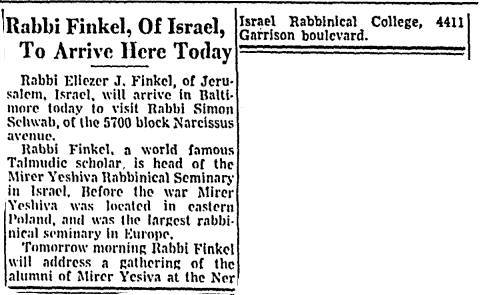
R’ Finkel was Rosh Yeshiva of Mir in Poland and the son of the Alter of Slabodka. R’ Finkel was influential in saving the Mir Yeshiva throughout WW2 and eventually re-establishing it after the war in Israel.

Shearith Israel 90th Anniversary
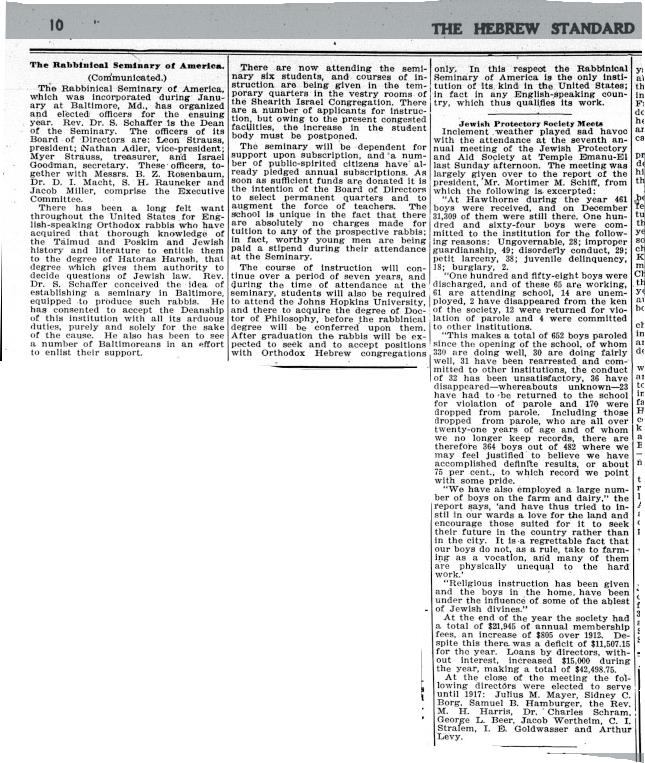
Rabbinical Seminary of America, Incorporated in Baltimore, 1914, Rabbi Shepsel Schaffer. This yeshiva was intended to be a version of the Hildesheimer Yeshiva in Berlin, graduating Orthodox boys in the “Rabbi Doctor” model – rabbis with college. It was open for a very short time. Ner Israel would open 19 years later in 1933.

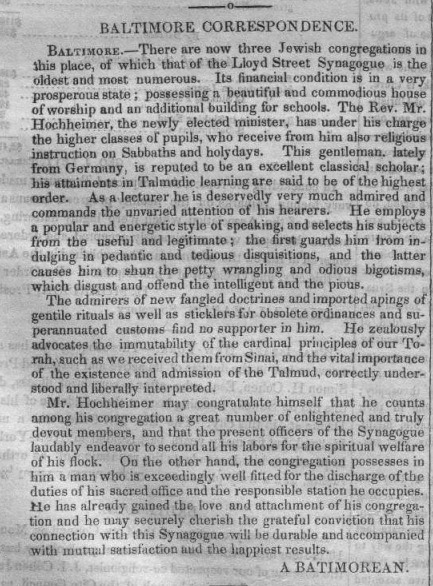
Lloyd St, aka Baltimore Hebrew Congregation, was founded in 1830. Har Sinai Congregation was founded in 1842 as a radical Reform congregation.
What was the third congregation in June 1850?
Oheb Israel Congregation (Fell’s Point Hebrew Friendship, Eden Street Synagogue) organized in 1838, and was chartered in 1847.
Additionally, Shearith Israel, or some version of it, was very likely in existence in the home of Rabbi Abraham Rice by 1850, as he had already vacated his position at Baltimore Hebrew. So while not a formal congregation, it was likely an existing minyan service. By 1851, it was considered the “Fifth Synagogue.”
Temple Oheb Shalom, which was formed in 1853 was also referred to as the “Fourth Synagogue.”
Still, Earl Pruce makes note that “about 1850, following a disagreement concerning holding Sunday morning services, some members of Har Sinai left the congregation and formed an independent on in a rented hall at Gay and Front Streets. … members [returned] to Har Sinai after about six months.”
- Both the McCulloh and Glen Avenue locations built mikvaot (ritual baths). In fact, Nathan Adler kept the mikvah at the new Glen Avenue building quiet, so as not to draw complaints due to the “traditional” aspect of a mikveh, as the general movement was away from these ideas.
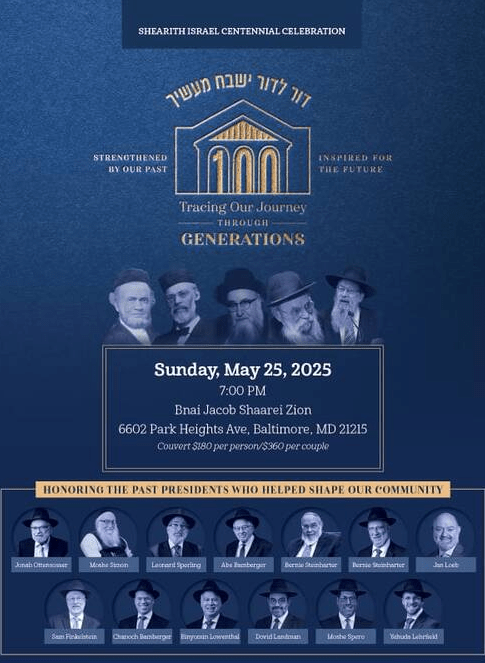
More info will be added as I continue to research this important synagogue. So please continue to refer back.
Thank you to Earl Pruce, Dr. Yitzchok Levine, Mr. Arnold Blumberg, Rabbi Moses Schwab, Rabbi Elchonon Oberstein, Mr. Eli Schlossberg for helpful information in compiling this historical piece.
Further reading:
Earl Pruce, “Synagogues, Temples, and Congregations of Maryland: 1830-1990”
https://web.stevens.edu/golem/llevine/blumberg_shearith_1970.pdf
https://www.wherewhatwhen.com/article/yom-tov-and-shabbos-memories
https://www.wherewhatwhen.com/article/shearith-israel-congregation-0
Rabbi Dr. Dovid Katz on “Nathan Adler & Rabbi Shimon Schwab: A Baltimore Story”
 Baltimore Jewish History
Leave a reply to Kenny Friedman Cancel reply