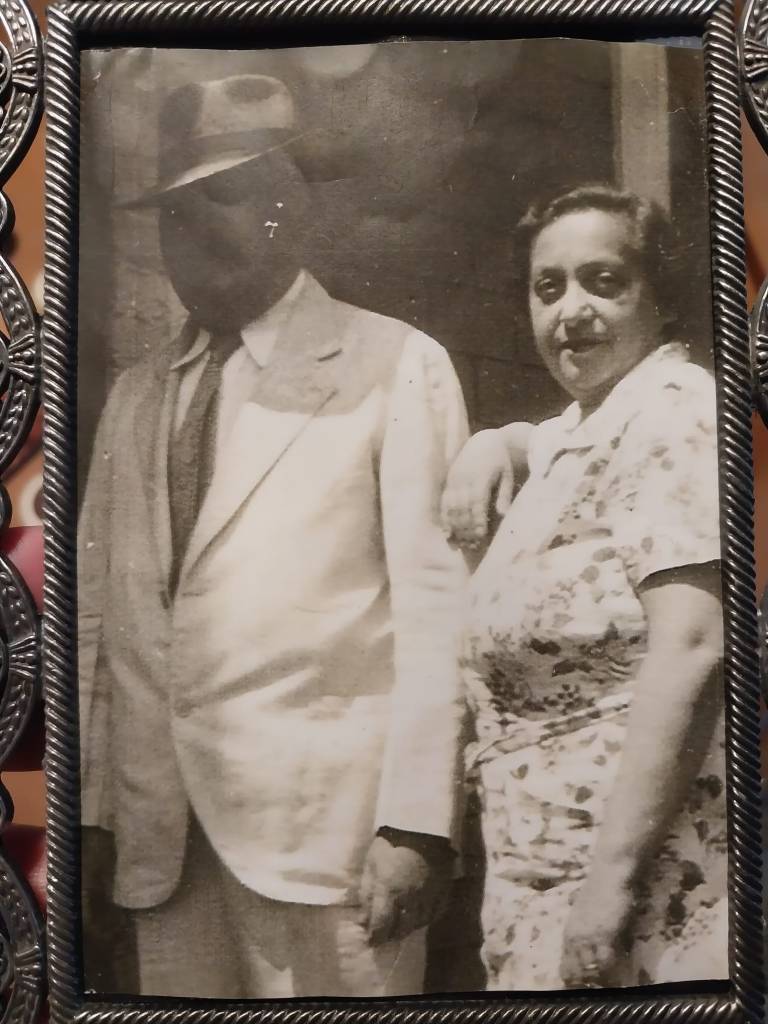
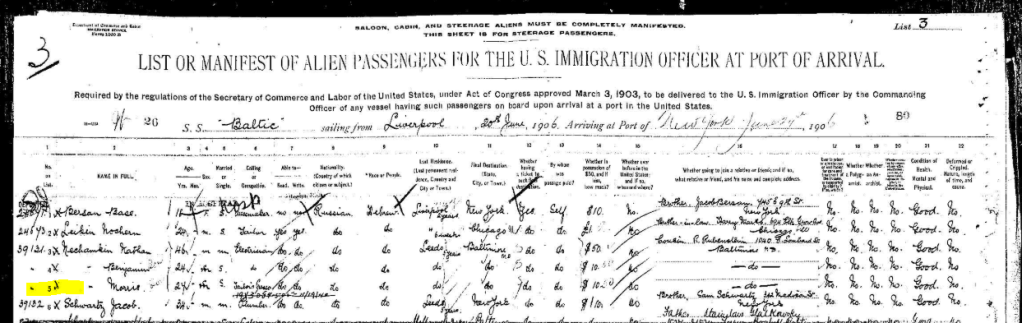
Today, 15 Iyyar, is the yahrzeit of my dear mother’s father, our Zaidy, Morris (Moshe) Nechamkin, who came to the United States on the S.S. Baltic traveling from Liverpool to Ellis Island with the final destination of Baltimore, MD. The ship left Liverpool on January 20, 1906 and arrived on January 29, 1906. He was leaving his hometown of Nizhyn, Ukraine, fleeing two decades of murderous pogroms, after 5 years of living in Leeds, England. He arrived to America with $10 in his pocket.
In the 19th century, Nizhyn was a center of the Lubavitch dynasty, which sadly, like most of European Jewry was decimated by bloodthirsty antisemites.
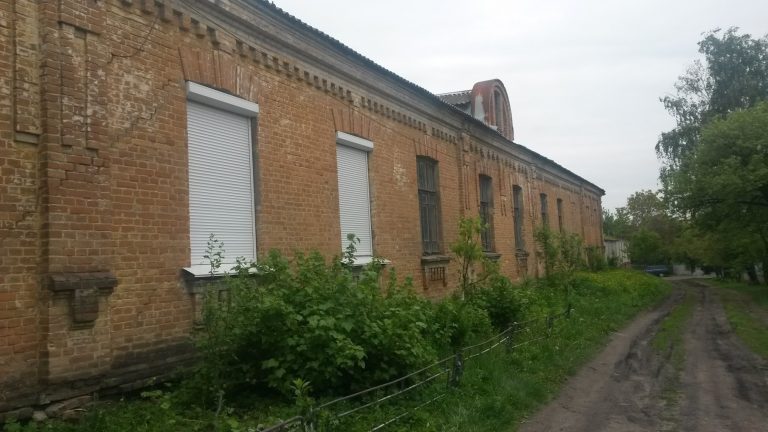

“Nezhin, city in Chernigov district, Ukraine. Jews first settled in Nezhin in the early 17th century, but the community was destroyed during the Khmelnitski uprising. They resettled there in the early 18th century. The ẓaddik Dov Ber of *Lubavich, the son of *Shneur Zalman of Lyady, the “middle rabbi” of Chabad Ḥasidism, died and was interred in Nezhin in 1827. The town became a center for the Chabad Ḥasidim of the Ukraine. It was especially well known while Israel Noah Schneersohn lived there from 1867 to 1882. In 1847, 1,299 Jews were registered in the community; in 1897 there were 7,631 Jews (24% of the total population). The waves of pogroms which overtook Russian Jewry on July 20–22, 1881, and in 1905 also affected the Jews of Nezhin. On September 2, 1919, Nezhin’s Jews were attacked by soldiers of the “volunteer army” of *Denikin, 100 Jews were killed, many women raped, and much property pillaged. The dead included Menahem Mendel Ḥen, rabbi of Nezhin. The Yiddish poet *Mani-Leib (Mani-Leib Brahinski) was born there. In 1926, there were 6,131 Jews in Nezhin (16.1% of the population), their number dropping in 1939 to 2,725 (7% of the total population). The Germans occupied the town on September 13, 1941. Most of the Jews succeeded in escaping. The few dozens who remained were killed by October 1941. In 1959 there were 1,400 Jews (3% of the total population) in Nezhin. (From Jewish Virtual Library, taken from S.M. Dubnow and G.I. Krasny-Agman (eds.), Materialy dlya istorii antiyevreyskikh pogromov v Rossii, 2 (1923), 153–4, 348–57; Die Judenpogrome in Russland, 2 (1909), 287–94; I.B. Shekhtman, Pogromy Dobrovolcheskoy Armii na Ukrainie (1932), 323–6.)

Luckily for me, you could say, Zaidy Nechamkin had the foresight to leave these soils filled deep with Jewish blood in time to save himself and his future descendants.
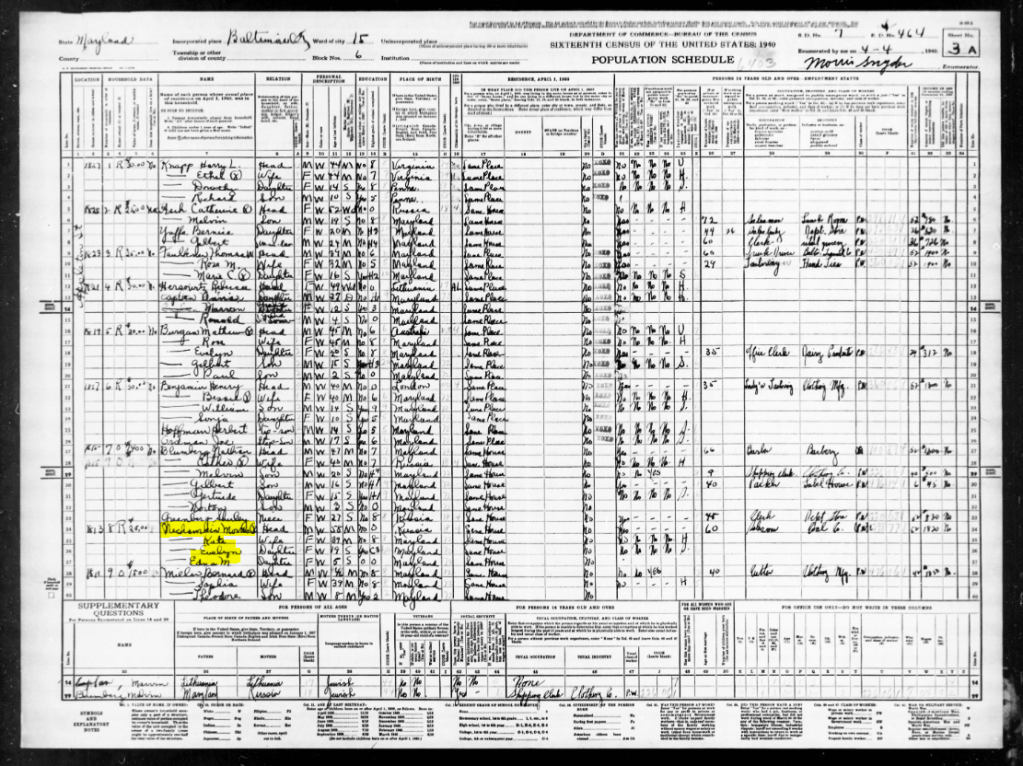
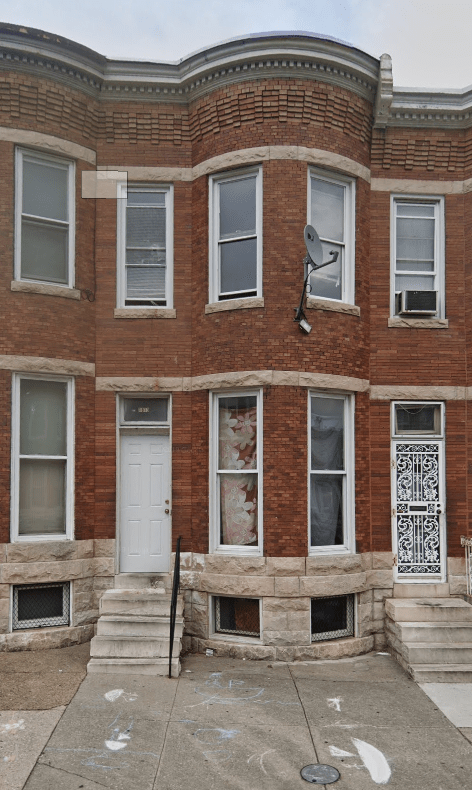


In the story above, from the January 11, 1921 Baltimore Sun, you will see my grandmother, the newly married, Kate Nechamkin listed. Her father, and my great grandfather, Jacob Brown, was murdered by a robber on January 10, 1921 inside his grocery store at 1121 Argyle Avenue. My Zaidy and Bubby would live in my great grandmother’s home until they would buy a home at 3753 Reisterstown Road in 1940.
I never met Zaidy Nechamkin, unfortunately. He passed away in 1949. But he was a man who was involved in many of the frum proceedings of his time. He was the president and longtime gabbai of his shul, Anshe Neisen Congregation. He helped to found Bais Yaakov of Baltimore in 1942 and was involved in Talmudical Academy, which was immediately in my mom’s neighborhood of Park Circle.
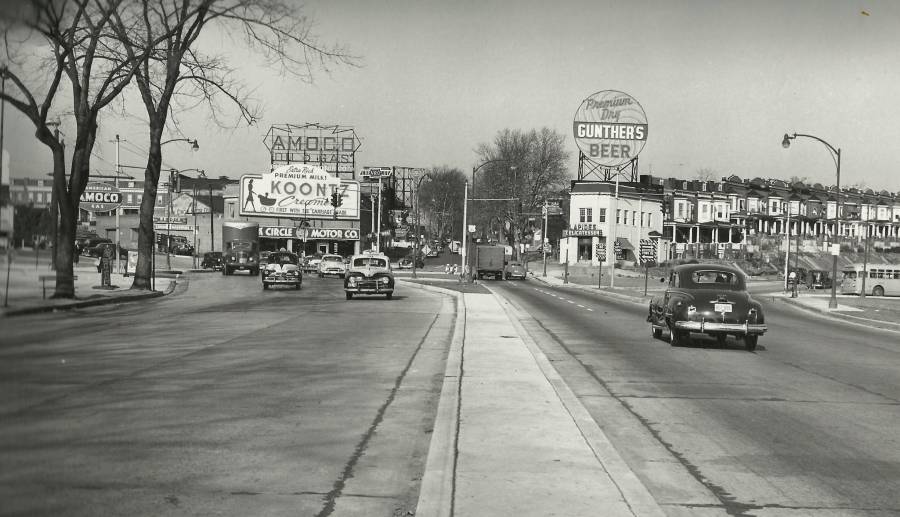
In fact, Rabbi Samson lived across the street. He was involved in the Chevra Kadisha and many other organizations. You see, while Baltimore was a bustling Jewish town by the 1930s, there were few truly frum people, as so many either did not want to be or more likely, were not able due to the inability to not work on Shabbos. The late 1930s would, of course, begin to bring people fleeing the Holocaust to Baltimore, and some of the most notable names in frum Baltimore’s last 90 years. But in the decades before, the shomer Shabbos crowd was intimate and all known to each other. As you can imagine, my mother remembers the Ruderman family of Ner Yisroel very well, as well as other early Baltimore luminaries.

A favorite story of our family’s, as my mom has told us many times, is that Harry Tulkoff, of iconic Tulkoff Horseradish fame, would come to my grandparent’s home to sing zemiros on Shabbos with my grandfather.

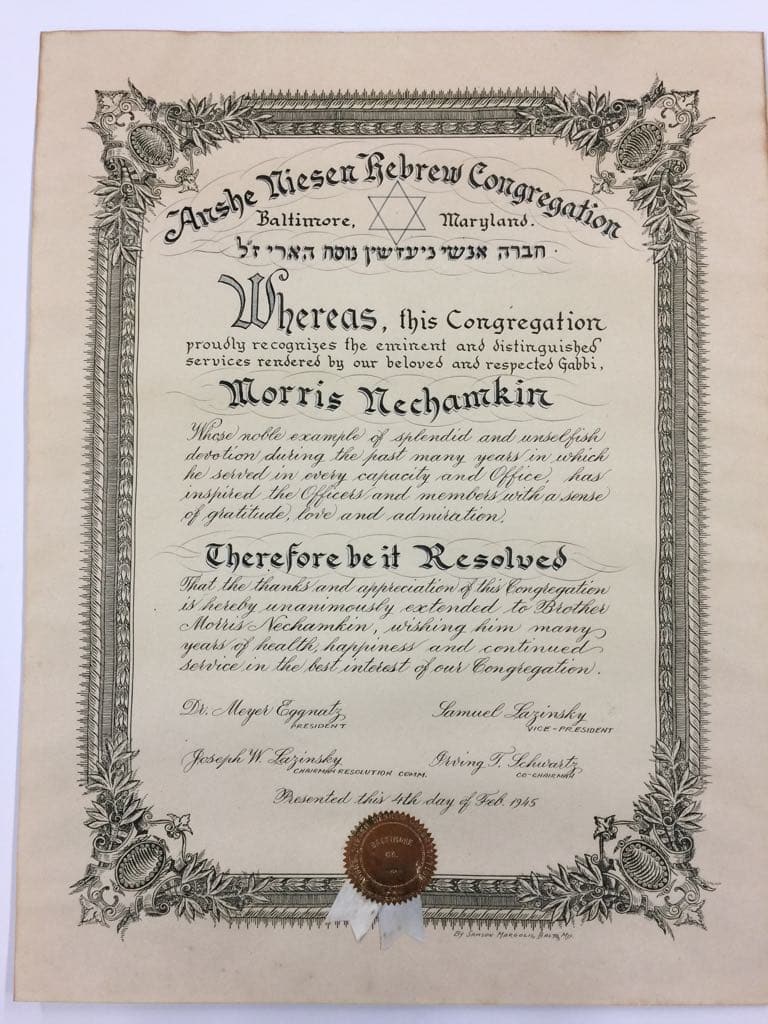
Zaidy Moshe Nechamkin was one of 9 siblings, and the only one to remain frum upon his arrival on these shores. He would sacrifice greatly to remain shomer Shabbos, always working for himself to ensure his convictions. He would come to America at age 24 in 1906 and marry my Bubby, Kate (Gittel) Nechamkin (nee Brown), an American born in Baltimore in 1899, in 1919, a wedding officiated by Rabbi Avraham Nachman Schwartz, the “chief rabbi of Baltimore.” Zaidy Nechamkin was 37 and Bubby Nechamkin was just 20.

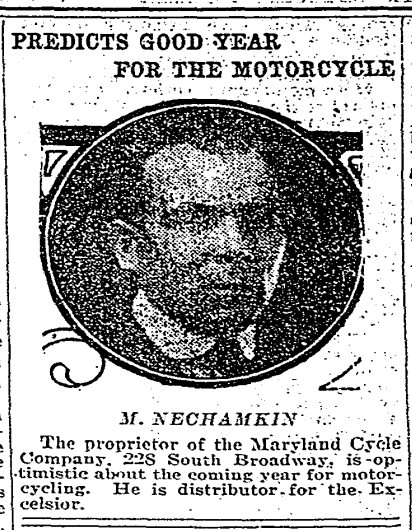
They would have one daughter, my Aunt Evelyn, in 1921, then struggle for many years until their second daughter, my mom was born. Zaidy Nechamkin would own various businesses and some real estate. I think my greatest research find was an ad from a 1914 Baltimore Sun featuring an ad with his photo. The advertisement was for his motorcycle sales store, the Maryland Cycle Company, located at 228 S. Broadway, in Fell’s Point. I had never seen a photo of him at that age. How many people can say their Zaidy owned a motorcycle store in Fell’s Point?
On January 19, 2020, just weeks before our father passed away, my brothers and I took the first step of saving important historical artifacts of Zaidy Nechamkin’s shul, Anshe Niesen Nusach H’Ari Hebrew Congregation (Nesina, Nezhin, Nyezhin).


Pictured is a wall hanging listing donors that contributed toward the building of Congregation Anshe Niesen between 1890-1920. Among these names is the name of my grandfather, Moshe Nechamkin, z’l, who is listed as a donor in the Jewish year 5671 (1910). In 1954, this wall hanging was restored by the sisterhood of Anshe Niesen and ultimately was placed in the chapel at the Anshe Niesen cemetery, 6300 Hamilton Ave. in Rosedale after the shul closed in the early-1950’s.
Recent to us saving these artifacts, the chapel had been broken into multiple times and the front door destroyed and windows broken. It was important to remove these old treasures so that they remain as a testament to those who built the shul. Anshe Niesen was the first Lubavitch congregation founded in Baltimore, as it was incorporated Dec. 1, 1890. With the movement of the Jewish community from East Baltimore, the shul closed about 1953.
Locations: 819 E. Baltimore Street 1890-1894
Plowman St. near High St. 1894-1900
616 E. Fayette St. 1900-1902
16-18 N. Exeter St. 1902-1953
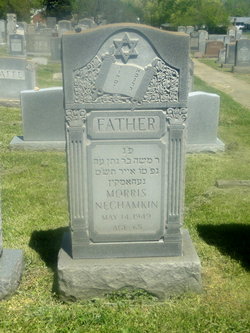
My Zaidy, Moshe (Morris) Nechamkin, was the longtime Gabbai and president of Anshe Niesen Hebrew Congregation. He and my Bubby, Kate (Gittel) Nechamkin (nee Brown) are buried in the Anshe Niesen cemetery. My family owes our Judaism to these holy people who sacrificed to be Sabbath observant at a time when it was highly difficult.
We were able to remove the old wall hanging and it is now part of a display of early Lubavitch in Baltimore at Chabad Center and Lubavitch of Baltimore, AKA Rabbi Kaplan’s Shul.
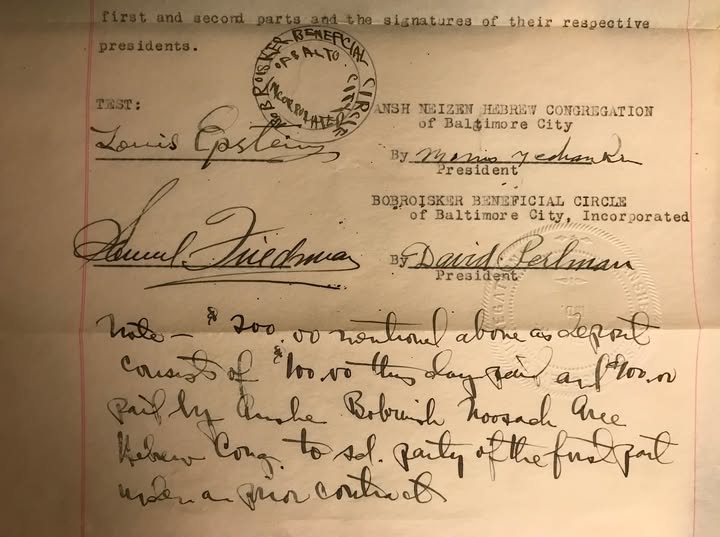
During other research some years ago on Anshe Neisen, I came across this document housed at the Jewish Museum of Maryland. It was not correctly marked with my grandfather’s name, but as I saw this, chills ran down my spine as I saw his clearly marked signature of “Morris Nechamkin, President, Anshe Neizen Hebrew Congregation of Baltimore City.” The document was a Deed of Sale from the Anshei Niesen Hebrew Congregation to Bobruisk Beneficial Circle for a plot of their land in the Rosedale Cemetery.
Zaidy Nechamkin was a man of deep convictions, often bailing out family members in financial distress and always putting others before himself. May his neshama continue to have the highest aliyah.
More pictures and history to come.
 Baltimore Jewish History
Leave a comment